Using Open Educational Resources with AI
Create AI-powered learning tools without copyright concerns
Overview
Imagine generating hundreds of practice problems matched to your learning objectives in minutes instead of hours. Or instantly updating your course examples to reflect this week’s news, keeping content fresh without the usual time investment. These possibilities are real, but there’s a catch: most commercial textbooks come with copyright restrictions that prohibit exactly this kind of activity.
This is where Open Educational Resources (OER) become valuable. OERs are teaching materials released under open licenses, which means you can freely use them in general (e.g. as course learning materials) and with AI tools. Adopting OER materials often provides the opportunity to experiment with AI-enhanced learning experiences, with the potential added benefit of saving your students money on textbooks.
This guide explains what OERs are, where to find them, and how to use them with AI tools to create richer learning experiences for your students.
In this guide:
- What are Open Educational Resources?
- Why does this matter for AI?
- Where can I find quality OER?
- Ideas for using OER with AI
- What to keep in mind
- References
What are Open Educational Resources?
Open Educational Resources are teaching and learning materials that anyone can freely access, use, adapt, and share. Unlike commercial textbooks, where publishers typically place restrictions on content usage, OERs are released under open licenses (most commonly Creative Commons licenses) that explicitly grant permission for educational reuse. A significant benefit of using OER materials is that it saves students money because the materials are made freely available.
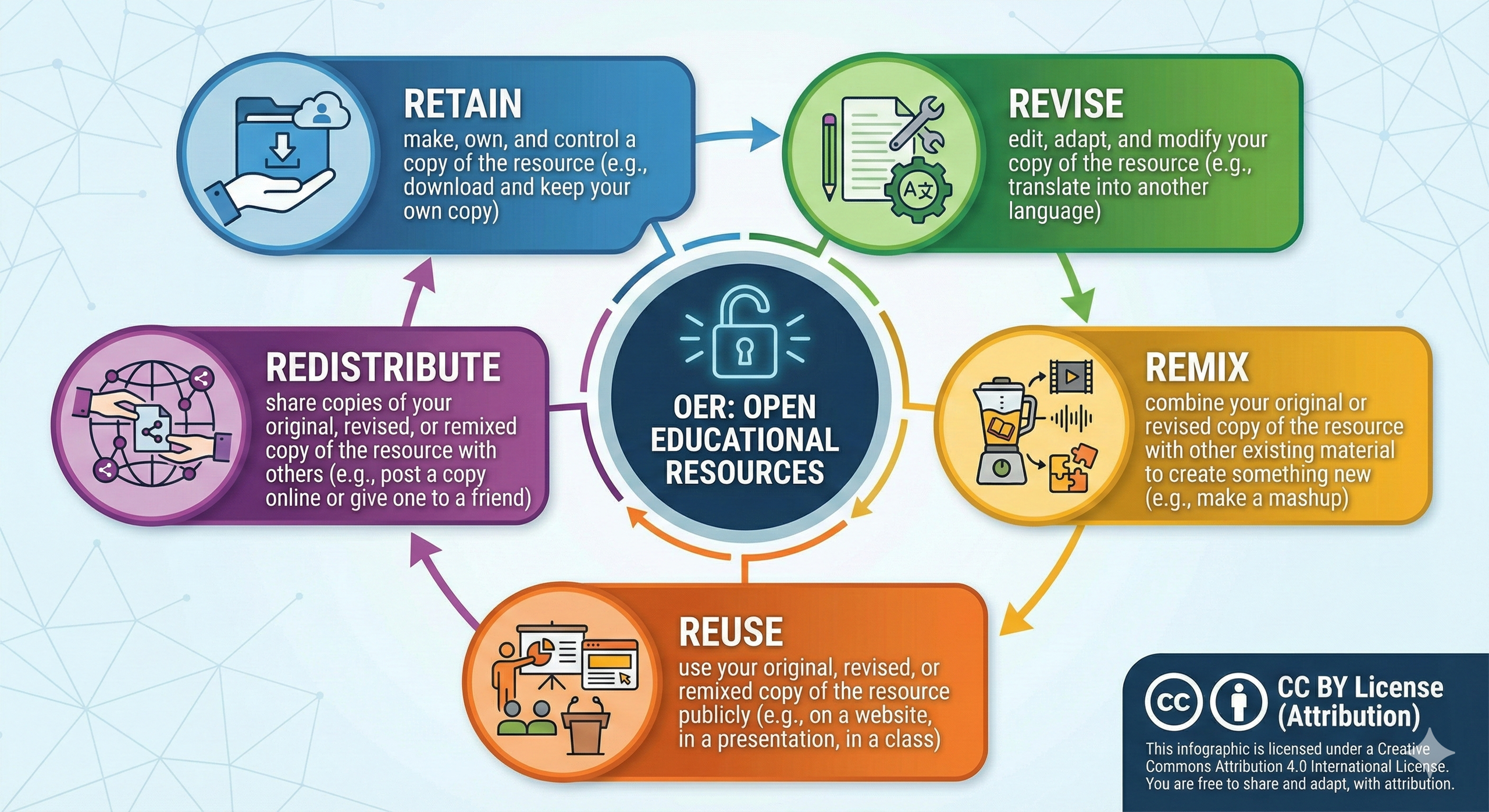
In practical terms, this means you can retain a permanent copy, reuse the material in your teaching, revise and update the content, remix it with other materials, and redistribute it to colleagues. These five permissions, sometimes called the “5 Rs,” distinguish OER from non-open copyrighted materials (Wiley, 2015).
OERs come in many formats: full textbooks, individual chapters, videos, simulations, problem sets, and more. Quality varies, but reputable sources like OpenStax offer peer-reviewed textbooks covering many introductory courses, and MIT OpenCourseWare includes vetted materials from a wide range of disciplines.
Why does this matter for AI?
When you upload content to an AI platform, you’re giving the system permission to process and work with that material. With commercial textbooks, this often conflicts with the publisher’s terms of service and copyright. Many commercial publishers explicitly prohibit uploading their content to AI tools, creating a barrier between faculty and one of AI’s most promising educational applications.
OERs can eliminate this barrier. Because most open licenses grant permission for reuse and adaptation, you can upload OER content to AI platforms without legal concerns. This makes it possible to create AI tutors trained on your exact course materials, generate practice questions aligned with specific chapters, and adapt content for the specific needs of your students.
The practical advantage is clear: when you can freely experiment with your course materials in AI platforms, you can iterate quickly, test different approaches, and adapt based on what works for your students without worrying about licensing restrictions.
Where can I find quality OER?
Not all OERs are created equal. Start with established repositories that emphasize quality and peer review.
OpenStax (openstax.org) offers free, peer-reviewed textbooks primarily for introductory undergraduate courses across many disciplines. These books are professionally designed and regularly updated.
MIT OpenCourseWare (ocw.mit.edu) provides materials from thousands of MIT courses, including lecture notes, problem sets, and sometimes video lectures. Quality is high, though materials may require adaptation for different institutional contexts.
OER Commons (oercommons.org) serves as a comprehensive search engine for openly licensed materials across disciplines and education levels. Use filters to find resources by subject, grade level, and license type.
When evaluating any OER, check the license terms to confirm the material permits AI use. Most Creative Commons licenses do, but some include restrictions on commercial use or require that adaptations be shared under the same license. Review the specific license before uploading to an AI platform.
Ideas for using OER with AI
Once you have open-licensed materials, you can begin experimenting with AI applications. Here are some creative ways faculty have used AI in conjunction with OER that add value to their teaching:
Custom course chatbots. Upload your OER textbook or course readings to an AI platform and create an assistant that answers student questions using your actual course materials. Students can ask for clarification on difficult concepts and receive explanations grounded in assigned readings. This can extend your availability without increasing your workload.
Practice problem generation. Use AI to generate additional practice problems based on OER content. You can specify difficulty levels, question types, and topics, then quickly produce problem sets that align with your learning objectives.
Adapted study materials. AI can help transform OER chapters into different formats for different learning needs: summaries for review, glossaries of key terms, or even podcast-style scripts.
Current examples and applications. You can use AI to instantly update examples in your OER materials to reflect current events or student interests. Unlike traditional textbooks that become outdated, open materials can be adapted on the fly to keep content relevant and engaging.
What to keep in mind
Adopting OER for AI use offers clear benefits, but a few considerations can help you get started smoothly:
Quality control remains your responsibility. Whether using OER directly or AI-generated content based on OER, review materials before sharing with students. AI tools can misinterpret source material or generate inaccuracies, so–as always–treat AI output as a draft that needs your expert review.
Attribution matters. Most open licenses require attribution. When you create AI-generated materials based on OER, maintain clear records of your sources and include appropriate credit. This respects the original authors’ work and models good scholarly practice for your students.
Finding the right materials takes time upfront. Depending on your discipline, high-quality OERs may be readily available or harder to locate. Start early and consider reaching out to colleagues or your institution’s library for assistance. Additionally, this can also be where you use AI to help you find materials that meet your needs and are also OERs. Northeastern’s library can often offer support with this process (contact Alyn Gamble: [email protected]).
Student benefits extend beyond AI applications. OER adoption saves students money. As important, research consistently shows that students using OERs perform as well as or better than those using traditional materials, with lower course withdrawal rates (Clinton & Khan, 2019; Colvard et al., 2018).
Understand the copyright considerations. The U.S. Copyright Office (2025) has clarified that content generated entirely by AI is not copyrightable. This means AI-generated material technically cannot be “licensed” under Creative Commons. However, when you use AI as an assistant, adding your own creative contributions, arranging AI outputs, or substantially modifying what the AI produces, the resulting work can still qualify for copyright protection and be openly licensed.
References
Clinton, V., & Khan, S. (2019). Efficacy of open textbook adoption on learning performance and course withdrawal rates: A meta-analysis. AERA Open, 5(3), 1-14. https://doi.org/10.1177/2332858419872212
Colvard, N. B., Watson, C. E., & Park, H. (2018). The impact of open educational resources on various student success metrics. International Journal of Teaching and Learning in Higher Education, 30(2), 262-276.
U.S. Copyright Office. (2025, January 29). Copyright and artificial intelligence, Part 2: Copyrightability. https://www.copyright.gov/ai/
Wiley, D. (2015). Defining the “open” in open content and open educational resources. Improving Learning. https://opencontent.org/definition