Process-focused Learning and Assessment for AI and Learning Skills
Back to AI Tips, Tutorials, & Recordings
Tasks that have traditionally required many hours of human labor—such as developing original text, analyzing massive datasets, generating complex computer code, and creating intricate illustrations—can now be done in a matter of seconds, with the help of generative AI. Across professions, this capability is shifting the role of the human in the workflow. Rather than focusing solely on generating output, people are learning to think strategically about how to effectively leverage GenAI to augment their work while infusing uniquely human skills into their processes (Dell’Acqua, et al., 2023; Harvard Business School Student Association, Inc., 2023). Such skills include critical thinking and judgment, for example.
Many scholars are calling on educators to mirror this workplace shift by focusing students’ efforts on not just the outputs of learning (such as test scores and papers), but on the processes of learning–including how students are using AI in completing their work (Bowen & Watson, 2024; Fadel, et al., 2024; Mollick, 2024). In addition to potentially preparing students for an AI-infused world, focusing on the learning process is an evidence-based strategy that has been shown to help students become better learners and develop self-awareness, thinking abilities, and other valuable skills they can leverage across academic, personal, and professional pursuits (Zimmerman, 1989). Further, process-focused assignments/assessments can lower the risk of students short-circuiting their learning with over-reliance on generative AI in completing their academic work.
Of course, most assignments will likely have features of both outcome-focused and process-focused approaches. The following table compares characteristics of these two approaches. The components in the right-most column may be considered a “menu” of possible assignment/assessment features. One or more of these features may be incorporated to make an assignment/assessment more process-focused regardless of whether AI is involved.
Features | Outcome-focused | Process-focused |
| Number of assessments/ opportunities to demonstrate learning | One (summative) | Multiple (formative; iterative and incremental) |
| Impact on course grade | Major (high stakes) | Minimal (low stakes) |
| Required assessment/ assignment output | Content, performance, or demonstration only | Content, performance, or demonstration as well as a verbal or written explanation of approach, rationale, and decision-making process |
| Purpose of feedback | Explain why the specific grade was given | Provide guidance that supports growth, development, learning |
| Who evaluates the work | Instructor | Instructor, learner and (sometimes) peers and/or external stakeholders, such as project sponsors or clients |
| Focus of assessment criteria | Quality of the product | Quality of the product as well as skills and processes demonstrated |
| Self-reflection component | No | Yes (an important component) |
Features of outcome-focused and processed-focused assignments/assessments
Incorporating features of process-focused assignments/assessments
The process-focused features in the table above can be incorporated through: 1) assignment/assessment structures that explicitly call for students to engage with GenAI in iterative and collaborative ways, 2) incremental and iterative assignment/assessment structures with feedback loops, 3) multiple opportunities for self-assessment and self-reflection, and 4) learning opportunities designed to cultivate thinking skills
1. Assignment/assessment structures for iterative and collaborative AI engagement
While students’ over-reliance on GenAI to complete their coursework can short-circuit the learning process, augmenting their workflow with these tools can activate important learning and thinking skills (see example structures below). It is recommended that students approach GenAI not as an authority on a particular topic, but as a collaborative partner that isn’t always correct. They should engage with it critically and iteratively to enhance and extend their learning.
Example structures
- Iteratively work with AI to generate a visual or a response to a complex question, evaluating the quality of output, and refining the prompt until the output meets established criteria.
- Prompt the AI to take a particular stance on a philosophical or controversial issue and engage in debate with the AI from an opposing stance.Analyze a problem-solving approach generated by the AI tool to identify inappropriate approaches, mistakes, or inefficiencies.
- Prompt the AI for brainstorming or editing support on a larger assignment.
- Prompt the AI to generate practice questions to prepare for an exam. Review the questions to ensure they are aligned with the course material and at the appropriate level of challenge.
- Refine and deepen one’s thinking by prompting the AI to interview the student about content they have created.
Assignment/assessments with these structures should include a learning process section or component that prompts for transparency and reflection on their AI usage, such as:
- What tool(s) did you use?
- In what way(s) did you use the tool(s)
- What were your prompts?
- What did you learn about strategies for effective AI use that you can apply in future assignments?
Such assignments might also require the student to include their AI chat transcripts with their assignment submission. Claude, Copilot, ChatGPT, and similar tools have a “copy” button in the chat for easily sharing the transcript.
NOTE: Most publication style guides have guidelines for citing AI-generated content. As an example, this post explains the APA guidelines.
2. Incremental and iterative assignment/assessment structures with feedback loops
Assignments/assessments can be structured for incremental and iterative development, resembling processes followed by professionals, such as writers who develop multiple rounds of drafts and edits before publishing, or engineers who go through multiple rounds of testing and feedback before launching a product. This type of structure works best when students have opportunities to actively construct their knowledge through projects, inquiry, analysis, writing, design, and other creative endeavors, which can help students learn how to learn while also activating thinking and other important cross-disciplinary skills (Hattie, 2009).
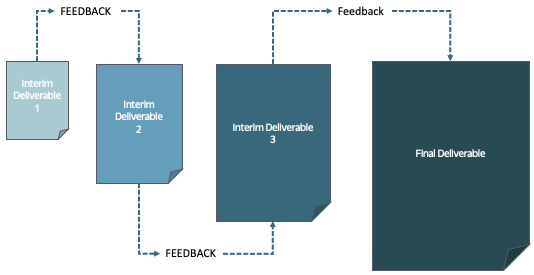
As illustrated on the right, iterative and incremental structures begin with foundational pieces like plans, sketches, and rough drafts, and build from there, incorporating feedback loops at each step of the way, until the assignment is complete.
Feedback loops are opportunities for students to not just receive feedback, but also to process and apply it to future iterations of their work. Feedback may be provided by the instructor, peers, and/or external stakeholders such as project sponsors. For maximum impact, feedback should serve as an interim step that guides students toward successfully completing and achieving the goals of the assignment (Ambrose, et. al, 2010). Feedback loops can benefit the educator as well. As Sadler (1989) put it, “the only way to tell if learning results from feedback is for students to make some kind of response to complete the feedback loop.”
3. Self-assessment and Self-reflection
Research has shown that engaging students in self-assessment and self-reflection can make them more self-aware and improve their learning processes (Zimmerman, 2009). Progress reports, exam and assignment wrappers, and final reflections can serve as vehicles for students to assess their work, reflect on their strengths and areas for improvement, and consider lessons learned.
The following are sample prompts for such activities.
- In what ways did you incorporate feedback received previously?
- In what ways does the work meet—and fail to meet—the desired results?
- What strategies and efforts have contributed most significantly to your positive results?
- What steps will you take to get better results next time?
- What skills do you most need to further develop?
- In what ways did you use generative AI and why?
- What specific generative AI tools did you use and why?
Such assignment components might also require the student to include their AI chat transcripts with their assignment submission.
NOTE: It may not be feasible for instructors of large lecture classes to give frequent feedback on individual work. However, it may be possible for students to conduct self- and peer assessments. Further, the instructor may spot check student work and provide feedback in aggregate for the entire class. Another possible strategy–when students are working in small groups–is to have groups present their work in class, verbally, and receiving high level feedback from the instructor as well as peers.
4. Assignment/assessment structures designed to cultivate thinking skills
Assignments/assessments are frequently designed to support students’ knowledge acquisition. However, skills and processes like problem solving, use of evidence, collaboration, and logic and reasoning are also essential across personal, professional, and academic pursuits. Such skills can be explicitly cultivated with assignment/assessment components and rubrics designed for this purpose.
- Components. Assignment components, or sections of a component may be designed to cultivate specific skills. For example, building in a planning or brainstorming document as an interim deliverable as part of a larger assignment could foster planning and organization skills. In another example, a rationale document or section may be incorporated into an assignment to facilitate students’ self-awareness, logic and reasoning, and application of important course concepts.
- Rubrics. Rubrics may include not only content standards, but also skills. In the rubric below is a set of basic learning skills and learning with AI skills, some of which you might choose for your rubric. Also shown is a possible scale for assessing the skills. From this menu of skills, those that you select should be relevant and appropriate for the developmental level of the student and other aspects of your learning context.
Basic Learning Skills | Rating (1-3 or NA) | Evidence of Skills |
| Carefully follows all instructions | ||
| Effectively plans and organizes the work | ||
| Promptly seeks help when needed | ||
| Effectively leverages resources and solves problems | ||
| Demonstrates thoroughness | ||
| Collaborates effectively | ||
| Applies clear logic and reasoning | ||
| Clearly explains the rationale for and concepts behind decisions and approaches | ||
| Uses evidence to support claims | ||
| Uses appropriate sources and cites them properly | ||
| Demonstrates curiosity | ||
Learning with AI Skills | Rating (1-3 or NA) | Evidence of Skills |
| Adheres to course policies and guidance regarding acceptable use of generative AI | ||
| Effectively engineers prompts for desired output | ||
| Effectively evaluates and modifies AI output for optimal results | ||
| Identifies potential bias in AI output |
Rubric for evaluating skills with sample skills shown
3 = High competence
2 = Moderate competence, needs a little work
1 = Low competence, needs significant work
NA = Not applicable
Summary
Learning is a process, not a destination. As such, process-focused assignments and assessments include evaluation of not only content, but also important cross-disciplinary skills and learning processes. Intentionally fostering these kinds of skills and processes can prepare students for an AI-infused world while helping students become better learners and simultaneously lowering the risk of students short-circuiting their learning with over-reliance on generative AI. Strategies for making assignments and assessments more process-focused include: 1) Assignment/assessment structures for iterative and collaborative AI engagement, 2) Incremental and iterative assignment/assessment structures with feedback loops, 3) self-assessment and self-reflection, and 4) assignments and assessments designed to cultivate thinking skills.
References
Ambrose, S. A., Bridges, M. W., DiPietro, M., Lovett, M. C., & Norman, M. K. (2010). How learning works: Seven research-based principles for smart teaching. John Wiley & Sons.
Bowen, J. A., & Watson, C. E. (2024). Teaching with AI: A practical guide to a new era of human learning. JHU Press.
Dell’Acqua, F., McFowland, E., Mollick, E. R., Lifshitz-Assaf, H., Kellogg, K., Rajendran, S., Krayer, L., Candelon, F., & Lakhani, K. R. (2023). Navigating the jagged technological frontier: Field experimental evidence of the effects of AI on knowledge worker productivity and quality. SSRN Electronic Journal. https://doi.org/10.2139/ssrn.4573321
Fadel, C., Black, A., Taylor, R, Slesinski, J., Dunn, K. (2024). Education for the age of AI. Center for Curriculum Redesign.
Harvard Business School Student Association, Inc. (2023). AI won’t replace humans – but humans with AI will replace humans without AI. News Bites – Private Companies https://link.ezproxy.neu.edu/login?url=https://www.proquest.com/wire-feeds/harvard-business-school-student-association-inc/docview/2849341481/se-2
Hattie, J. (2009). Visible learning: A synthesis of over 800 meta-analyses relating to achievement. Routledge.
Mollick, E. (2024). Co-intelligence: Living and working with AI. Penguin.
Sadler, D.R. (1989). Formative assessment and the design of instructional systems. Instructional Science, 18(2), 119-141.
Zimmerman, B. J. (1989). A social cognitive view of self-regulated academic learning. Journal of Educational Psychology, 81, 329–339. http://dx.doi.org/10.1037/0022-0663.81.3.329
Back to AI Tips, Tutorials, & Recordings